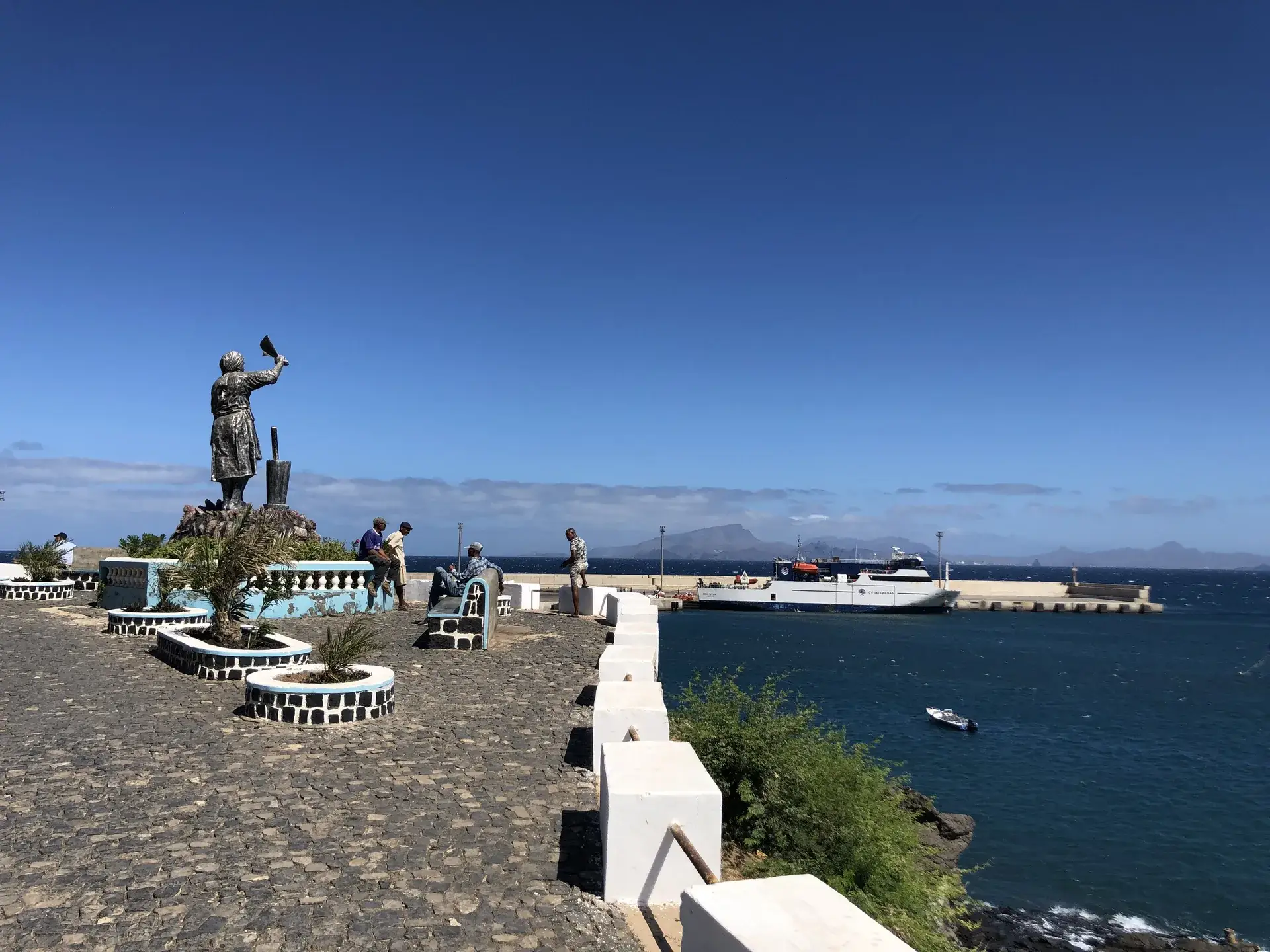
You step off the ferry on Santo Antão, walk down the village path towards the market, and hear something you don’t recognise. Not the Portuguese you brushed up on at home. Not the English you fall back on. Something else, with its own rhythm, its own sounds, its own logic.
That’s Kriolu. And it’s what happens to most travellers the first time they set foot in a Cape Verdean village. The language you hear is not the language you expected.
The question of what language they speak in Cape Verde doesn’t have one answer. Officially it’s Portuguese. In the street it’s Kriolu. And depending on the island, that Kriolu sounds different again. At Kasa d’Vizin in Eito, in the middle of the Paul Valley on Santo Antão, every morning starts with a plant-based breakfast and a few Creole words we explain to our guests. That says most of what you need to know about how language works here: formally it’s one thing, in daily life it’s something else entirely.
In this article you’ll learn the difference between the official language and everyday speech, which island variants exist, what you’ll run into in which situation, and which phrases you can use straight away.
Portuguese or Kriolu: how language works in Cape Verde
Portuguese on paper, Kriolu in daily life
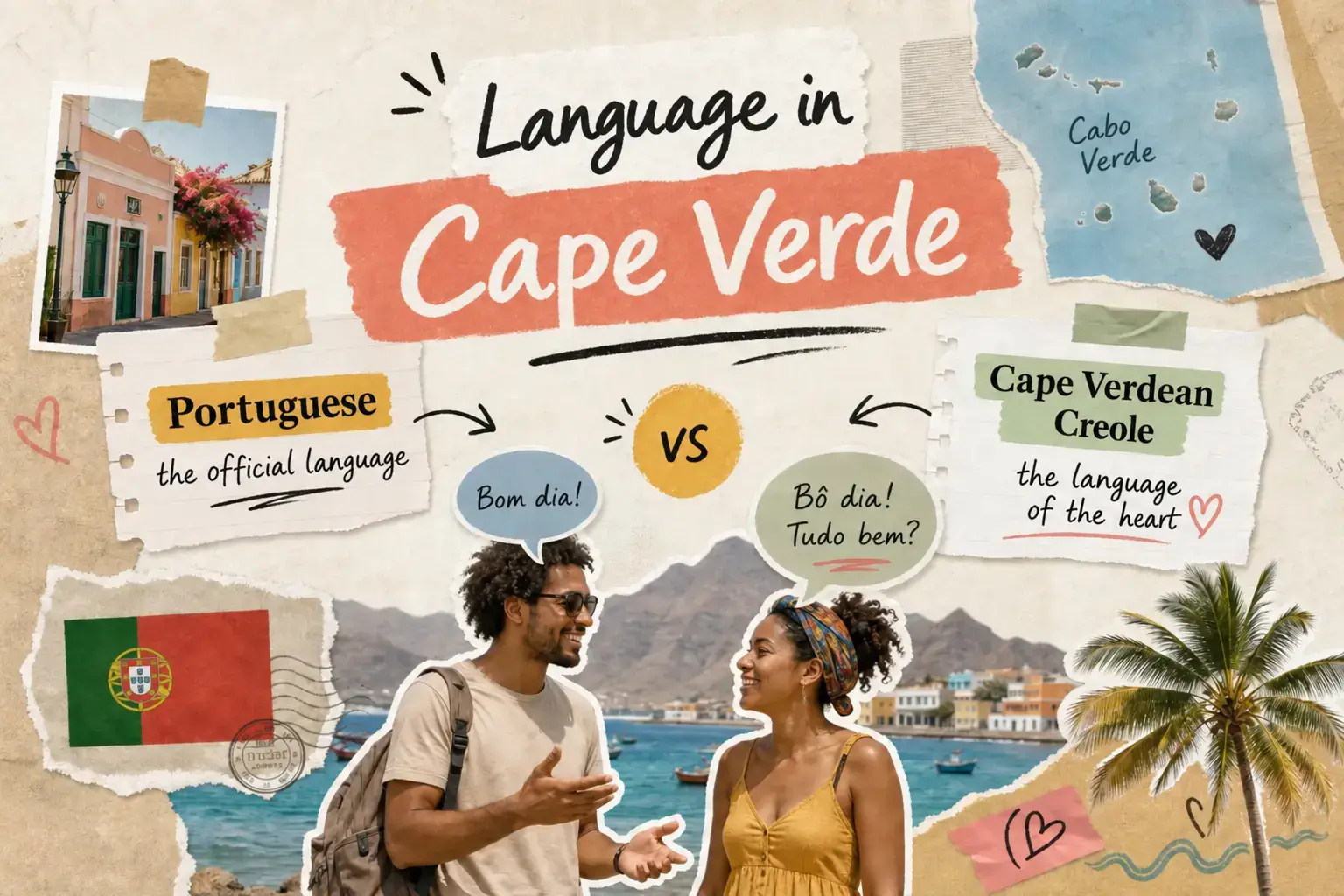
Portuguese is the official language of Cape Verde. It’s the language of schools, government, official documents and national media. Children learn to read and write in Portuguese, in line with the language policy the country has followed since independence in 1975. Forms are in Portuguese. But when those same children come home, when neighbours greet each other in the street, when two friends stand talking on a path: that’s Kriolu.
A traveller who speaks Portuguese will be understood by most Cape Verdeans, although that varies by region and age group. The reply almost always comes in Kriolu, the language people actually think and feel in. You notice the difference the moment you walk into a village.
Two languages, two jobs
Linguists call this diglossia: two languages living side by side, each with its own domain. Portuguese does the formal work. Kriolu does the social and emotional work. That’s no accident. It’s the direct result of centuries of colonial history and island life. As a traveller you meet both: Portuguese on signs and in official situations, Kriolu the moment you start a conversation with someone from the village.
How Cape Verdean Creole came to be (and why it’s not an accent)
A language born from contact
Cape Verdean Creole, also called Crioulo or Kabuverdianu, emerged in the fifteenth century. The islands were uninhabited when the Portuguese arrived in 1462. People from many different West African groups were then brought to the islands. Portuguese settlers, sailors and people with very different African mother tongues had no common language. What grew out of that was new: a contact language none of them had ever spoken before.
Its own grammar, its own sounds, its own logic
Kriolu is not sloppy Portuguese. It has its own grammar, its own word order and sounds that differ sharply from Portuguese. An average Portuguese speaker doesn’t automatically understand Kriolu. That matters if you’re travelling: knowing a few words of Portuguese doesn’t mean you’ll follow conversations in the street. Kriolu is related to Portuguese, but it’s a separate language with its own history and identity, shaped over centuries.
Island variants: does Santo Antão sound different from Santiago?
North and south: Barlavento and Sotavento
Cape Verdean Creole isn’t one uniform language. Each island group has its own variant. The southern islands, the Sotavento group including Santiago and Fogo, speak variants more strongly influenced by West African languages. The northern islands, the Barlavento group including Santo Antão, São Vicente and São Nicolau, speak variants that sit a little closer to Portuguese in pronunciation. All variants are related, though, and together they form one Cape Verdean Creole, not separate languages.
One audible difference: on Santiago the r at the start of a syllable sounds rounder and fuller, while on the Barlavento islands you’ll more often hear a softer, almost whispered sound. Small, but noticeable once you listen for it.
The Santo Antão variant: what you hear in the Paul Valley
In the villages of the Paul Valley, like Eito, you hear the Barlavento variant of Kriolu. It has its own rhythm and sound that set it apart from the Santiago variant. Villagers speak almost exclusively Kriolu among themselves. If you understand a little of the local variant, you experience a different layer of the island: not the island as it looks, but the island as it sounds.
What you actually hear: village, hiking trail and tour guide
In the village and at the market
In the smaller villages of Santo Antão, Kriolu is the language you hear everywhere. Most people understand Portuguese, but they nearly always answer in Kriolu. At the market, at the baker’s, along the water channel: anyone who tries a few Kriolu words gets a smile in return. Travellers who use local words tend to get warmer reactions than those who stick to their own language. That’s not a Cape Verde thing. That’s how language works everywhere.
On hiking routes and with local guides
Hiking guides on Santo Antão generally speak Portuguese, and depending on their background French or English too. As soon as they talk to villagers on the trail, they switch to Kriolu. That’s the moment you, the hiker, stop understanding anything. A few basic words change that immediately.
Kasa d’Vizin as your starting point
At Kasa d’Vizin in Eito, guests start the day with a plant-based breakfast made with fresh produce from local farmers. At the table we explain the Creole words and expressions you’ll meet on the trail or in the village that same day. There’s a printed phrase list ready, and if you want to practise or strike up a conversation with someone from the village, we’re happy to help. That way language becomes something you pick up as you walk, not something you learn from a book beforehand.
Kriolu for the road: the greetings that open every door
A few words are enough to break the ice. Start with these, they work anywhere on Santo Antão:
- Bon dia, good morning
- Tudu dretu?, all good? [CHECK: align spelling with the phrases post once a native Barlavento speaker has reviewed both]
- Obigadu / Obigada, thank you (male / female speaker)
The pronunciation feels familiar: most words sound close to Portuguese, with sound differences per variant. Say them slowly, with a soft rhythm, and you’re most of the way there. You don’t need to memorise anything, just be willing to try.
If you want the full set, we put together the 25 Kriolu phrases hikers actually use in Paul Valley, in the Santo Antão dialect you’ll really hear, with pronunciation hints. It covers the trail, the market and the table, including the two phrases you hope you’ll never need: I’m lost, and can you help me.
English, Portuguese or Kriolu: what you’ll actually need
Do people speak English in Cape Verde?
In hotels, with organised excursion companies and with guides who work with international travellers, English is usually enough. In the villages of Santo Antão it’s a different story. At the local kiosk, in an aluguer full of villagers, or when something goes wrong on a remote trail, English won’t get you far. Portuguese helps more. Kriolu always wins.
For transport and emergencies
For arranging transport, an aluguer or minibus, Portuguese works reasonably well. Drivers and guides in a tourist context often speak English too. But in an unexpected situation on a remote path, it helps to know how to ask for help or describe where you are. Write down a few key phrases beforehand, or save our phrase list on your phone before you leave the village.
How a few words of Kriolu change your stay
Show respect for the language, even if it’s just a greeting, and you’re received differently. Cape Verdeans genuinely appreciate the effort. It changes more than the conversations. It changes the atmosphere of your whole trip. Not as a tourist trick, but as an honest gesture towards people welcoming you into their village and their lives.
So, the short answer to what language they speak in Cape Verde: officially Portuguese, day to day Kriolu. And on Santo Antão that’s the Barlavento variant, the Kriolu you hear in every village of the Paul Valley, in every greeting on the trail, in every conversation along the levada.
You don’t need a language course. A few greetings, a few words for the trail, and the willingness to try. That’s enough. Not as homework, but as a way to get closer to the island than most travellers ever do.
At Kasa d’Vizin in Eito, that starts at breakfast, before the day’s hike. We explain the words you’ll need that day. And when you come back in the evening, there are always new ones to learn. That’s how language works here: not something you study, but something you hear, try, and slowly start to recognise