There are roughly two kinds of hikers who head up the valley in the morning. One says “hello” to the first farmer he passes and gets a polite nod back. The other tries “Bon dia, tudu dretu?” and gets a grin, a handshake, and sometimes the short cut up the hill that isn’t on any map.
I run Kasa d’Vizin, our four-room house in the middle of Eito. I’m no linguist, and my own Kriolu is still far from perfect. But I sit at the breakfast table here every morning, and I see the difference a few words make. Not because people are otherwise cold. They’re not. Cape Verdeans are warm, full stop. But make the effort to greet someone in Kriolu and you step straight into a circle that stays closed to most visitors.
That’s what this is about. Not a language course, just the phrases you’ll actually use on the trail, at the market, and at the table.
Kabuverdianu is not bad Portuguese
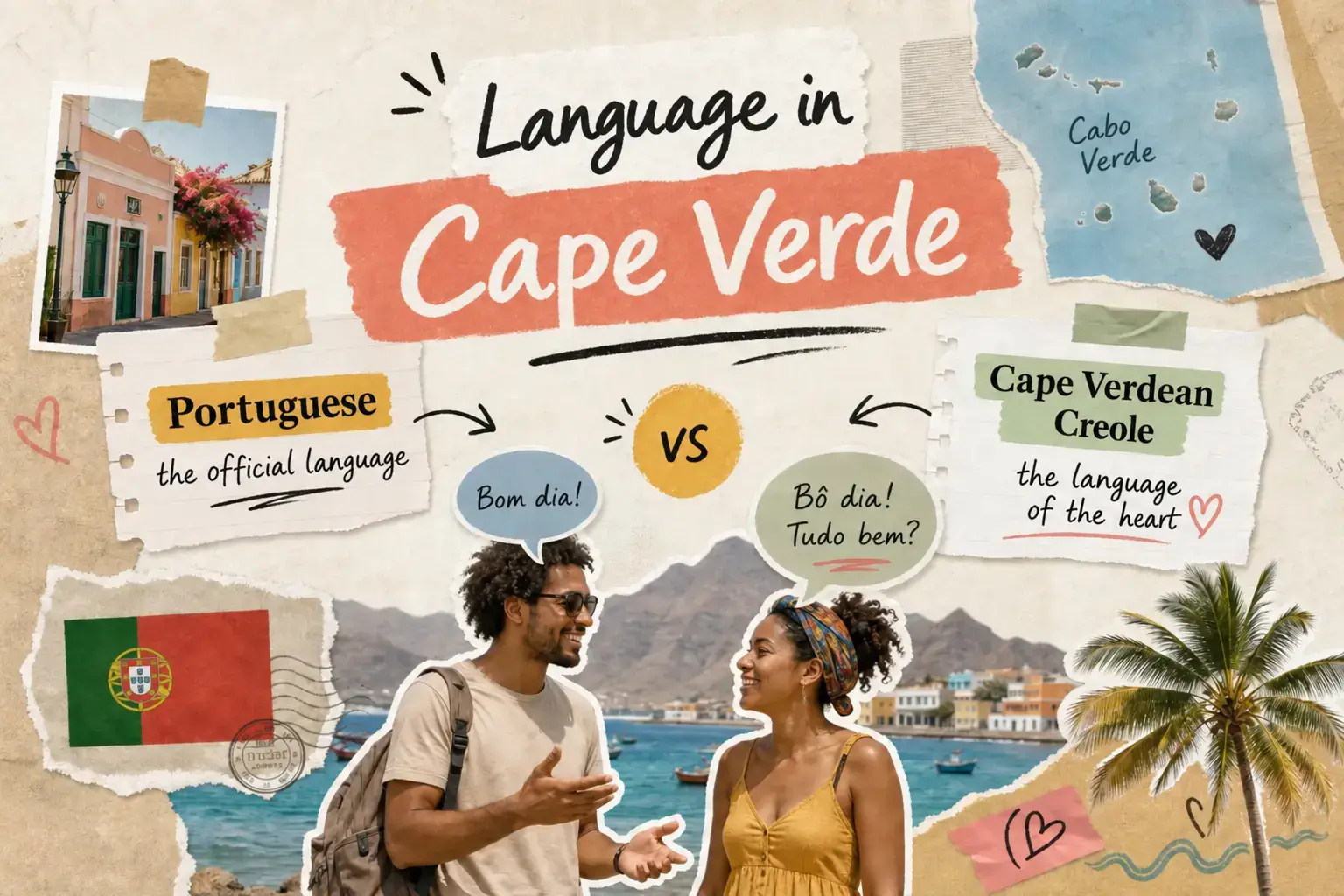
Let me clear one thing up, because it’s stubborn in guests’ heads. Kabuverdianu, also called Kriolu, is not simplified or “broken” Portuguese. It’s a language of its own, with its own grammar. Yes, most of the vocabulary comes from Portuguese. But the sentence structure, the sounds and the expressions are their own thing. If you want the longer story, how Kriolu grew out of a few hundred years of contact and why it sounds different from island to island, we wrote that up in what language do they speak in Cape Verde.
That matters in practice. Portuguese is the language of school, newspapers and official forms. On the trail, in the shop and at the kitchen table, you hear Kriolu. More than ninety percent of Cape Verdeans grow up speaking it. So three words of Kriolu open more doors here than a whole conversation in laboured Portuguese, and you’ll notice it immediately in how people respond.
On Santo Antão it sounds different from what you find online
This is the trap most guests fall into. You practise a bit at home, arrive, and nobody sounds like your app.
Kriolu has roughly two dialect groups. Santo Antão, São Vicente and São Nicolau belong to the northern one, the Barlavento group. Santiago and Fogo to the south, Sotavento. Most of the material you’ll find online is Santiaguense, the southern dialect. It sounds different here.
One concrete example you can use straight away: with us, you say n’ for a negation. “Mi n’ kre” is “I don’t want to”. On Santiago they’d use ka: “N ka kre”. Small stuff, but it’s the difference between sounding like a guidebook and sounding like someone who knows where he is.
The villages up here, Eito, Chã de Igreja, Cabo de Ribeira, hold on to an older spoken language, close to classic Barlavento. More African sound influences, less of the city speech you’d hear on Sal. The phrases below follow that spelling.
How to say it
Kriolu uses the same letters as Portuguese, but the pronunciation often drifts from what you’d expect. Three rules get you furthest:
- “au” becomes a short, closed “o”.
- “x” sounds like the “sh” in “shoe”.
- End vowels half-disappear. The language swallows opening and closing sounds.
And then the advice that actually pays off most, and that no app gives you: speak slower than you want to. Say a phrase carefully and slowly and you’ll get far more goodwill than if you rattle it off wrong. Can’t get the sound right? Smile, point, repeat. Works almost every time, and it gets a laugh on both sides. That laughing isn’t a side note, by the way. It’s half the job.
The 25 phrases
Split across the three situations you’ll definitely land in as a hiker here. Barlavento spelling, with a rough pronunciation hint.
Greetings and manners on the trail
Greeting isn’t optional here, so start there. “Bon dia” in the morning, “Botárdi” in the afternoon, “Bonóti” in the evening. “Modi ki bu sta?” is “how are you”, and you’ll hear it all day. More casual, and usually the better opener with someone you pass, is “Tudu dretu?”, literally “all straight?”. Thanking someone is “Obigadu” if you’re a man, “Obigada” if you’re a woman.
- Bon dia / Botárdi / Bonóti – good morning / afternoon / evening
- Modi ki bu sta? – how are you? (mo-dee kee boo sta)
- Tudu dretu? – all good? (too-doo dreh-too)
- N sta dretu – I’m doing well (n sta dreh-too)
- Obigadu / Obigada – thank you (o-bee-ga-doo / o-bee-ga-da)
- Na nada – you’re welcome (na na-da)
- Favor – please (fa-vor)
Out on the trail, in the hills
Two phrases you hopefully won’t need but will be glad to know: “N sta perdi” (I’m lost) and “Bu podê djuda-m?” (can you help me?). To say where you’re heading, stick a place name after “N kre bai pa…”. Say “N kre bai pa Chã de Igreja” to someone on the path and chances are you’ll get an arm pointing the right way.
- N sta perdi – I’m lost (n sta per-dee)
- Bu podê djuda-m? – can you help me? (boo po-de zhoo-da-m)
- Unki ki ta fika…? – where is…? (oon-kee kee ta fee-ka)
- N kre bai pa… – I want to go to… (n kre bai pa)
- Kantu ki custa? – how much is it? (kan-too kee koos-ta)
- Ta ten awa? – is there water? (ta ten ah-wa)
- Ke ora ki e? – what time is it? (ke o-ra kee e)
At the market and at the table
At the market in Porto Novo or a stall in the village you’ll get by with “N kre un bokadi di…” (I’d like a bit of…) plus the name of what you want, “manga”, “banana”. And the phrase that earns a smile at every table: “A comida sta sab”, the food is good. Say it after a meal and you’re further than most visitors ever get.
- N kre un bokadi di… – I’d like a bit of… (n kre oon bo-ka-dee dee)
- A comida sta sab – the food is good (a ko-mee-da sta sab)
- E sab! – it’s delicious! (e sab)
- N ka ta kume karne – I don’t eat meat (n ka ta koo-me kar-ne)
- N ka ta bebe alkol – I don’t drink alcohol (n ka ta be-be al-kol)
- Undi ki é snack bar? – where’s the snack bar? (oon-dee kee eh)
- Bu fala Ingles? – do you speak English? (boo fa-la ing-gles)
- Un fotos, favor? – a photo, please? (oon fo-toos fa-vor)
- N sta kansadu / kansada – I’m tired (man / woman) (n sta kan-sa-doo / kan-sa-da)
- Ate logu – see you later (a-te lo-goo)
- Bon viagem! – safe travels! (bon vee-a-zhem)
It isn’t only about the words
One thing that catches Western guests off guard: greeting here is a social obligation, not a choice. Walk past a house, you greet. Step into a shop, you greet first and ask for what you need after. Skipping a greeting reads as rude, even when you don’t mean it that way. With older people, add Senhor or Senhora. Costs nothing, and it lands.
What might feel like overdone formality back home is simply the normal register of a day here. Eye contact, a real smile, a handshake on a first meeting. Adjust to that and the rest follows on its own.
Practising, at home and here
If you want to prepare beforehand: the Peace Corps Kriolu lessons are free online and structured for beginners, and “Learn Kabuverdianu” has a dictionary with audio. There are apps too, but check the store yourself for what’s current, since that changes.
More important than the source is the method. Say the phrases out loud, not in your head. To the mirror, into your phone, doesn’t matter. The language has its own rhythm and you only pick that up by speaking it. Ten minutes a day in the week before you travel beats an evening of cramming at the airport.
And the honest part: you don’t have to finish this at home. We keep cards with the most-used phrases in every room, so you start on arrival. We swap a few words with guests over breakfast anyway, and on the walks through the valley you learn it the way it’s meant to be learned, in motion, with people who speak it every day. No lesson. Just talking on the trail.
One last thing
You don’t need to master the language to connect. A few phrases, an honest attempt and the willingness to laugh at your own pronunciation are enough. The farmer on the path might ask where you’re from. A child will want to know your name. And the woman at the market might slip an extra mango into your bag because you greeted her in Kriolu. Those are the moments that stay with you, long after your boots have dried out.
Want to practise it on the spot, in the middle of Paul Valley? Then you know where to come. With us in Eito, over breakfast, a stack of phrase cards, and a hiking route that starts at the door.